Taking Steps To Master Songwriting #2
28 May
Weakness is not failure. It is direction.
Last session, I asked you to list out your strengths and weaknesses as a songwriter. The purpose of that exercise was not self-criticism, but awareness. Before we can grow creatively, we need to understand the foundation we are building from.
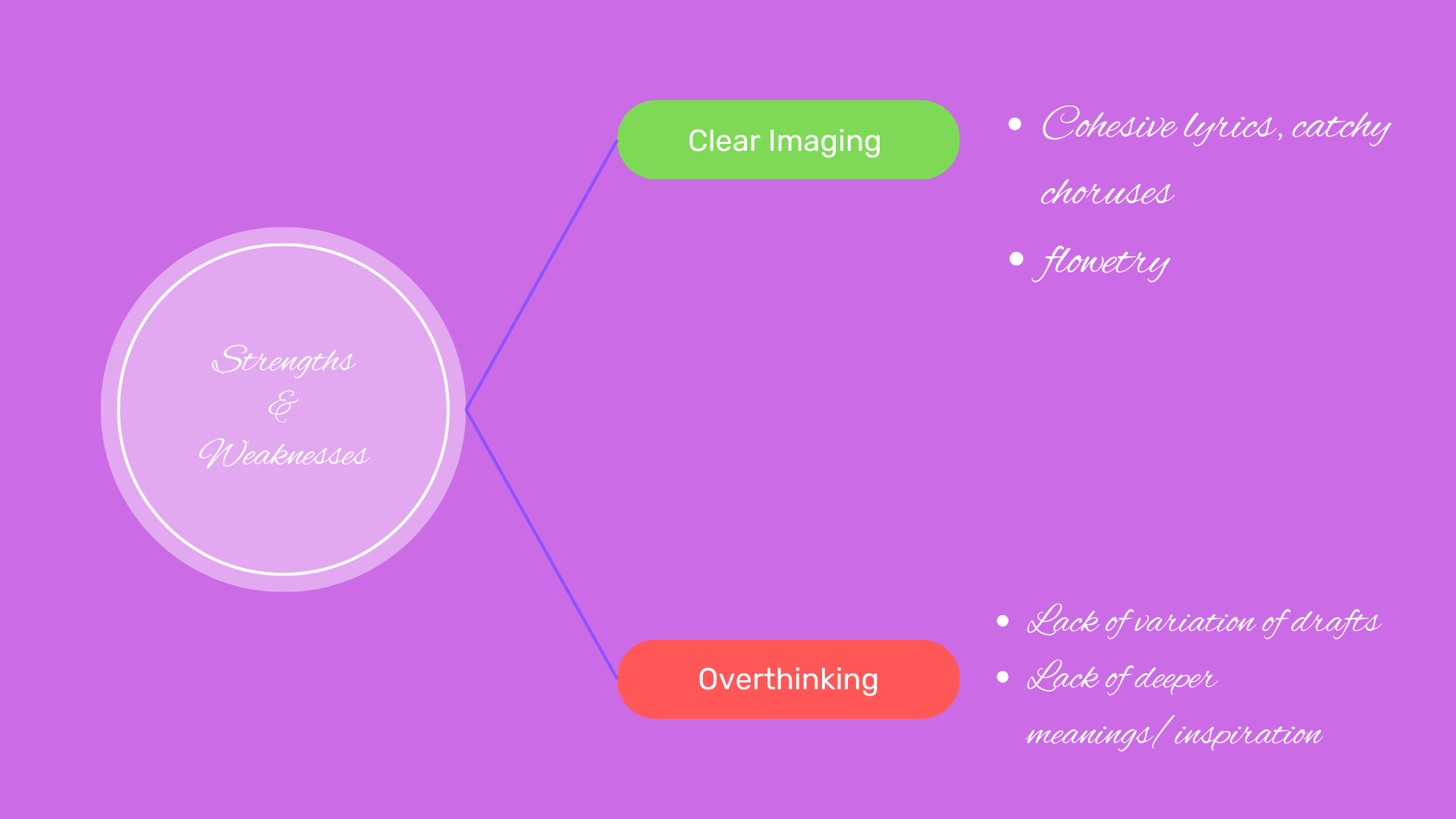
I identified 2 of my qualities from both ends of the spectrum. My strengths included clear imagery and natural flowetry. My weaknesses included overthinking and a lack of variation between drafts. At first it is easy to view weaknesses as obstacles, but in reality they are gateways. They show us exactly where growth is waiting.
If we continue writing songs in the same way we always have, we will often recreate versions of what we already know how to do. Creativity expands when we challenge our habits.
So first
let’s choose one weakness to work on.
For me, I chose my lack of variation of drafts. When I reflected on this, my initial question would be WHY? Why is this a persistent action I keep doing when writing a song?
When I write my songs, I typically write the full lyric sheet in one sitting, which could be seen as a strength. There is momentum, instinct, and emotional honesty in writing without stopping. But it could also be a limitation on my creativity. When a song arrives too quickly, I rarely pause to explore alternative emotional direction or unexpected imagery. The song feels finished but not fully discovered.
“Create like a child and edit like a scientist” - Tyler The Creator
Songs grow when writers allow friction, revision and surprise. I wrote a mini blog on the concept of being burnt out: Life is a ying and yang circumstance. When the scale is tipping one way, it sure can tip the other way too. Instead of seeing burn outs as a devastating ‘I must give up’ state, try looking at it from a ‘maybe I need a new scenery’ perspective. As creatives, our mind loves to dissect our interest of topics right down to exhaustion. Obviously, to reach a state of burn out often is quite unhealthy for your brain. However, I believe that once an artist hits a wall and feels stuck, it means that is is time for a new creative experience. - The Art From Burn Outs
Many artists speak about breaking their own creative habits in order to evolve. Growth rarely comes from repeating what feels comfortable. It comes from experimentation.
This is where we introduce what I call controlled disruption- intentionally stepping outside of your natural writing pattern to open a new creative pathway.
The W.A.V.E Method
Throughout these sessions, we will follow a creative framework called the W.A.V.E Method. Songwriting is not about fixing yourself as a writer. It is about understanding how you create, challenging your habits, and allowing your voice to grow.
W-Witness
Notice your patterns. What do you do naturally? what do you repeat without noticing?
A- Ask
Question those habits. Why do you write this way? What emotions or styles do you avoid?
V-Vary
Experiment intentionally. Change perspective, structure, or tone to interrupt routine.
E-Expand
Keep what surprises you and allow it to become part of your evolving voice.
Today’s lesson lives in the V stage- Vary
The next step in this process is applying variation intentionally.
In the extended edition, I introduce an exercise called The Three-Draft Method, designed to disrupt your natural writing habits and reveal new creative directions.
